
Educators across New York City are enjoying their remaining days of summer and beginning to feel what those of us in the profession call, the “Sunday Scaries". "The Scaries” are rooted in the responsibility we hold for educating our students and anxiety over the few things we have control over in our day to day. We’re thinking about the activities we’ll do with our students to get to know them and each other, setting classroom routines and structures and how we’ll work to ensure they are seen throughout the curriculum to ensure they learn and grow as human beings.
Acknowledge, we must, that we are living in uncertain times and this directly and indirectly impacts all of us. We value that our pedagogical training involves understanding cognitive science and child development. This knowledge reveals that teaching and learning are social and emotional behaviors and guide our teaching to ensure that it is appropriately challenging, developmentally relevant and meaningful. Most likely, we’re already thinking about the personalities and contexts our students will be bringing to school at the beginning of September and how we can make our classrooms and schools safe and engaging spaces.
We care about what and how we teach. We are deeply invested in ensuring that our curriculum is grounded in relevance and meaning. We know more about what our students need than people outside that reality. Curriculum writers and many education reformers impose their ideas of what teaching and learning should look like but lack pedagogical foundations, knowledge of human development, city and state standards, and the context of a school day. In fact most curriculum writers have never been educators, and those who have taught average 2-3 years in the field. Let us be clear and honest- scripted curricula causes more harm than good. Being told to run any curricula to “fidelity” hurts students. Students are harmed by curricula that are developmentally inappropriate, perpetuate stereotypes, and time impositions that result in the reduction and removal of other important intellectual and curricular pursuits. Teachers working with packaged curricula are committing a load of extra labor to make it work for the range of students in their classes. Teachers teach students, not curriculum. A small number of schools have resisted the fad knowing that good teaching does not come canned. One size does not fit all.
Some argue that these curriculum products work and point to the recently released New York State test scores, which appear to show an improvement in student performance. There are multiple reasons for why this conclusion is faulty. There are a range of potential factors that could lead to fluctuations in standardized test scores; recent class size reductions, opt out percentages and New York State uses normed reference testing. Scores like on a statistical bell curve, skewing how “growth” is determined. In addition, test items are normed differently from year to year, deeming each year’s scores incomparable to the next and so on. We have seen the politicization of drops and improvements in test scores used for political advantages for different administrations. Prior to 2010, a drop in scores was attributed to an increase in immigrant student populations. In August of 2011, the Common Core was attributed with a rise in test scores. Retired NYC DOE data analyst, Fred Smith, provided a deeper insight into the numbers that revealed a correlation with political rationale for policy decisions. Psychometrics and statistical data analysis are not an area of expertise of most elementary educators (or school administrators). In fact, we’re made to not just believe in how the data is reported but to feel the pressures of performance in our day to day interactions with our students. The American Statistical Association put out this statement in 2014 decrying the use of value-added models for educational assessment.
Quick and easy fixes, in the form of packaged curricula and consultants, have been marketed and sold to us as the answer to what ails us. However, this distracts us from mountains of research that have connected student outcomes to financial stability at home, access to health care and other resources- all things that have been gradually stripped from our local fiscal and education budgets. We acknowledge that our city has a long history of under-serving and engaging in educational negligence for our most marginalized students. The burden of all of this has been placed on schools and we are at high levels of demoralization.
Unlike most cities, we have not had an elected school board since the start of the 2000s. New York City is the largest school district in the United States with approximately 1.1 million students, and 1,800 separate schools, with nearly every educational policy decision coming out of centralized decision makers. It’s important to ask who runs and makes monetary decisions for the largest education budget in the U.S. We want to direct the focus on following the many multi-million dollar contracts secured to continue a program of systematically dismantling public education in New York City.
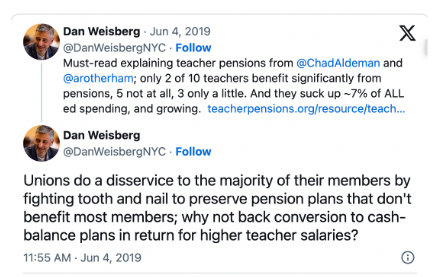
Since Mayor Eric Adams took office and made his placements to run the department of education, few people know that the recent outgoing Deputy Chancellor, Dan Weisberg, worked behind the scenes and was the primary and dominant figure behind curriculum contracts with, and most known for those connected with the NYC Reads initiative. It is vitally important, as educators, to ask what is behind the initiatives of someone who has no educational experience but has a background for being an anti-union attorney and a known corporate education reformer in his role as director of the New Teacher Project under Michelle Rhee. Not to make this about him but without understanding the source, we are being led into an assumption that fixing the literacy issue is connected to purchasing “the best” curriculum, undermining the complex and critical work of educators.
The rhetoric and marketing around the mandated literacy curricula for elementary schools (HMH, Expeditionary Learning and Wit and Wisdom) implies that these curricula are the “silver bullet” that will “fix” literacy instruction and “failing schools”. We are not focused on debating which curriculum works the best, since any experienced educator knows that boxed curricula serve as resources. Many of us who were grilled under the Teachers College Readers and Writers workshop model, were told that if students were not learning to read using the program, then we weren’t implementing it correctly. We were forbidden, in many schools, to use instructional strategies that veered away from “the program” even if we were trained in instructional practices that could work. We are being forced to yet, again, use another form of scripted curriculum.
Teaching begins with knowing our students well, and this requires having educators who are trusted and given the professional wherewithal to provide them with what works. There is no more important time than now for educators to be included in the discussion and decisions around what our students need to feel seen and empowered in their education. A major part of this is realizing the private interests that impact how and what we teach.

Reactions